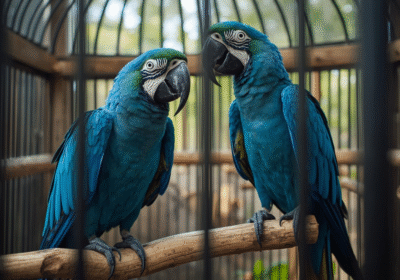

The blue-and-yellow macaw, scientifically known as Ara ararauna or blue-and-gold macaw, is a large parrot native to the Neotropics. This charismatic bird showcases a predominantly blue plumage on its back, accompanied by a vibrant yellow or orange underside and gradient shades of green on the head. Belonging to the macaw family, it inhabits various environments such as forests (particularly varzea), woodlands, savannahs in tropical Central and South America, and even the Caribbean island of Trinidad.
Blue-and-yellow macaws are highly sought after in the world of aviculture due to their eye-catching colors, ability to mimic human speech, easy availability in the market, and their fondness for bonding with humans. With a length ranging from 76 to 86 cm (30 to 34 inches) and weighing between 0.9 to 1.5 kg (2 to 3 lb), they are among the larger members of their parrot family.
Their appearance is truly captivating, featuring striking aqua blue feathers on their body, excluding the lime-colored head. The lower part of their body exhibits a rich deep yellow or light orange shade. Their beak is black, and the feathers beneath their chin also share this dark hue. Gray-colored feet, accented with black talons, provide stability. The face of the bird lacks feathers, with the exception of a few spaced-out black ones that create a striped pattern around the eyes. Pale, light yellow irises complete its facial features.
In their natural habitat, blue-and-yellow macaws have a lifespan of approximately 30 to 35 years and typically reach sexual maturity between 3 and 6 years of age.
In summary, the blue-and-yellow macaw, or blue-and-gold macaw, is an impressively large parrot found in the Neotropics. With its vivid blue and yellow plumage, unique facial patterns, and striking features, it captivates both bird enthusiasts and those interested in aviculture. Adapted to various environments, these macaws epitomize awe-inspiring beauty and are known for their potential longevity.